Friday, 10 September 2010

Review: The Girl with the Hungry Eyes

Vampires have never been more popular–a statement that is pretty frightening when you think about it. They seem to be everywhere. Go to any book stall and your bound to find a shelf groaning under the weight of vampire novels. Vampire films infest the marquees of cinemas around the world. Teenage girls moon after sparkly vampires. Older girls watch cable programmes about soft-core pornographic vampires. Graphic novels (comic books to anyone over forty) have more than their share. There are even would-be vampires who discover that imitating the fictional variety is a good way to end up in prison or the asylum.

Vampire detectives, vampire spies, vampire armies, vampire clans, vampire waitresses, vampire this that and the other; the only thing we don't see nowadays is the vampire vampire. It's a paradox. Modern society seems dead set on ringing every change out of the vampires. They've been portrayed as suave sophisticates, mindless zombies, exotic lovers, remorseless psychopaths, calculating gangsters, disaffected flatmates, stand-ins for"alternative lifestyles", and as safe, sparkly teenage love interests that make one suspect that vampire is a euphemism for gay boyfriend. Yet in all of this, what is lost is the essence of what the vampire is; what makes him terrifying and uncanny.

Most vampire fiction of the past few years has focused on the more materialistic aspects of the creature. A vampire drinks blood, which is portrayed as an unpleasant, but necessary diet. A vampire is vulnerable to certain things like stakes and sunlight, but it's on the same level as Superman and kryptonite. A vampire is immensely strong, can climb walls, and, last but most emphatically not least, the vampire is so sexually attractive that he makes Rudolph Valentino look like a dead pope. All well and good, but what is often ignored is that the vampire is a supernatural being; an animated corpse with a trapped, tormented soul that is possessed by a demon that feeds on the living. It is a creature that lives, for want of a better word, for the sole purpose of corrupting and destroying mortals. Modern writers often forget that Bram Stoker's Dracula was a stand-in for Satan himself and played a similar role in the story. Put it simply, vampires are monsters.

Blood is a perfect illustration of this. For the classic vampire, feeding off of blood isn't like a human being sitting down to a plate of chops. A vampire would never be satisfied with a blood substitute as in the Sookie Stackhouse novels, nor would it get any nourishment from hunting deer as in the Twilight series. Blood for the classic vampire is the conveyor of something much more fundamental and essential to the vampire. Blood is life itself. That is what the vampire feeds on and that is what makes it so frightening. It doesn't want a very runny black pudding. It wants to eat your soul.

This literal soul-sucking is best described in Fritz Leiber's sideways vampire short story "The Girl with the Hungry Eyes" (1949). The vampire here is a mysterious, nameless woman known as "The Girl". She's a professional model who has become a wild sensation across the country. Never smiling and with a strange hunger in her eyes, she stares out of billboards, magazines, and advertisements by the thousands, yet no one has ever seen her in person except for the photographer who snaps her picture and he wishes that he'd never met her. She shows up one evening at his studio and despite having zero experience as a model and impossible demands for anonymity, the cameraman's clients are soon falling over themselves to hire her.

The Girl is an unnerving character. She is utterly aloof, reveals nothing about her past, and when she talks to the photographer it's in a condescending tone that one would expect of a diner who granted an audience to the lobster he'd chosen from the restaurant tank. Our hero can't make up his mind whether he's attracted or frightened by her. And then the murders start as seemingly healthy men with no connection to one another are found dead around the city. He eventually comes to realise that she isn't exactly human. Indeed, she may not exist in any sense that he could understand; that she is nothing more or less than the personification of all the pent up lusts, desires, ambitions and frustrations in every man's heart focused in one place. When he finally confronts her, she describes her needs in a manner worthy of a Bride of Dracula:
I want you. I want your high spots and your low spots. I want everything that's made you happy and everything that's hurt you bad. I want your first girl. I want that shiny bicycle. I want that licking. I want that pinhole camera. I want Betty's legs. I want the blue sky filled with stars. I want your mother's death. I want your blood on the cobblestones. I want Mildred's mouth. I want the first picture you sold. I want the lights of Chicago. I want gin. I want Gwen's hands. I want your wanting me. I want your life. Feed me, baby, feed me.
Not a very sparkly moment nor a simple case in need of an attitude adjustment. A blood substitute would be wasted on such a succubus that Leiber has redrawn in a modern, urban setting.

In 1972, Rod Serling's Night Gallery aired their adaption of "The Girl with the Hungry Eyes". With script by Robert M Young and directed by John Badham, the teleplay was arguably superior to the short story, though it may be more of a matter of comparing a story in two different media. Besides, Leiber deserves to be offered a move and a pawn for not having Joanna Pettet around as his inspiration.

Aside from Miss Pettet, a woman who causes grown men to bite their fists and emit small animal noises, the television version fleshes out the story with some very strong dialogue, such as this speech by the beer baron Mr Munsch (John Astin) as he pleads with the photographer David Faulkner (James Farentino) to help him find the Girl so he can meet her:
There's something different about her, isn't there? It isn't sex or life or death or anything in between. Who is she? Find out. For all of our sakes, find out!
The Girl is what a vampire should be; seductive, unsettling, dangerous, hungry, and unearthly in a way that suggests more than immortality on a liquid diet. She promises everything, but only delivers a glimpse into the Pit.


H P Lovecraft: Part 5 of 5


Thursday, 9 September 2010

Review: Midnight by the Morphy Watch

If anyone was going to write weird fiction about chess, it was going to be Fritz Leiber. Though not as well known to the general public as Robert E Howard or H P Lovecraft, Leiber was one of the defining authors of American weird fiction and a pioneer of the urban horror story that plays off the inchoate fears of the city dweller. In novels like Conjure Wife and short stories like "Smoke Ghost" and "The Girl with the Hungry Eyes" Leiber took our clean, modern world that we pride ourselves as having thrown off the superstitious and populated it with a new demonology. University campuses become the hunting grounds of witches working to advance their husbands' careers, smog and oil become tangible monsters, and photographs spawn succubi.

"Midnight by the Morphy Watch" (Worlds of If, July 1974) is a perfect example of how Leiber was able make San Francisco seem like it was on the borders of Arkham and an innocent game of chess into a gateway to Hell. The Morphy Watch is one of the Chess world's greatest lost treasures and even in real life it was the centre of an incredible story. Paul Morphy (1837-1884) was one of the great geniuses of chess. A child prodigy, he was crowned (albeit unofficially) world chess champion when only 21. Returning to his native United States, he enjoyed a hero's welcome and a celebrity life. Accolades and prizes were showered on him–one of which was a specially commissioned watch given to him by the American Watch Company that had chessmen instead of numerals on the dial. Having beaten all comers and growing increasingly eccentric, Morphy suddenly declared that chess had no more challenges for him and he retired from the game for good. Morphy later pawned the fabled watch and it passed into the hands of Arnous de Riviere. It vanished some time after 1921. It's whereabouts a mystery, Leiber provides an answer.

In "Midnight by the Morphy Watch", the titular timepiece (sorry) is rediscovered by Stirf Ritter-Rebil, an aging chess enthusiast and antiquarian, in a San Francisco secondhand shop of the sort that only do business in the pages of weird fiction. The watch is bit more elaborate than its real-life counterpart and Ritter (as he prefers to be called) soon discovers that he has purchased more than an historical curiosity. At a local chess tournament, he finds that his atrophied chess skills are returning. In fact, he is playing better than ever. Soon he is winning game after game and progresses to defeating masters while blindfolded in a simultaneous match against four opponents. As Ritter's powers grow, so does his mania for the game. He can't stop thinking about chess or dreaming about it. The game becomes literally all-consuming in Ritter's expanding mind. It also doesn't help that he is haunted by four spectral figures and a prowling "something" with a hint of the cosmic about it.

The story is a simple one with a neat twist at the end, but Leiber is able to flesh it out with his bold writing style. The characters are vivid and distinct. Ritter is fully realised and comes off the page in a way that is economical, yet effective. One suspects that there is a bit of Leiber mixed in him. Leiber's word pictures are neat little stories in themselves, such as the part where a dusty window is cleaned, without detracting from the main action. His descriptions of San Francisco linger and his blending of the earthly and the unearthly is masterful.

In all, as tidy a gem as one of Morphy's games.

H P Lovecraft: Part 4 of 5


Wednesday, 8 September 2010

Quote of the day

Books have the same enemies as people: fire, humidity, animals, weather, and their own content.
Paul Valery

Review: The Walls of Eryx

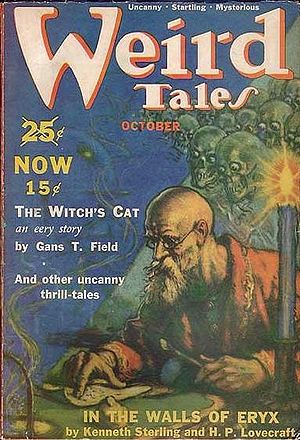
H P Lovecraft is remembered as the most influential and perhaps the greatest writer of weird fiction of the 20th century, but during his life, Lovecraft remained an impoverished writer who never had a book published and who supplemented the meager earnings from his short stories by selling his services as editor and ghost writer. Never a businessman, he didn't prosper at this either. It did, however, provide Lovecraft with an opportunity to branch out into subjects that he normally wouldn't have considered and in the 1936 Lovecraft took over a manuscript by Kenneth Sterling, which he rewrote and it was eventually published after Lovecraft's death in the October 1939 issue of Weird Tales under the tile of The Walls of Eryx. Though not the best or even the more adequate of Lovecraft's collaborations, it is notable as his single foray into interplanetary adventure fiction.

The Walls of Eryx tells of the fate of Kenton Stanfield, a prospector from Earth who is hired by a mining company to hunt for Venusian crystals that are sources of tremendous energy. Unfortunately, they are also worshiped by the primitive reptilian natives, who do not take kindly to the Earthmen's gathering them and are a constant hazard. So far, it sounds a bit like the plot of Avatar, but the natives are scarcely Cameron's noble savages and Stanfield soon learns that the natives have a sadistic streak wide enough to land an A380 on.

Lovecraft/Sterling's Venus is, in keeping with the science of the 1930s, a hot, humid jungle world teeming with all manner of life and, this being Lovecraft, none of it is scenic or beautiful and all of it is unpleasantly deadly. Stanton can only survive in the poisonous atmosphere with a chemically-charged oxygen mask and he is clad head to toe in a leather suit to protect him from the local nasties. Prospectors of the future apparently travel very light because outside of some food tablets, a knife, a "flame gun" and a crystal detector, Stanton seems rather under-equipped for a jungle expedition.

Stanton's seemingly routine outing (if ambushes and an encounter with a hallucinatory cannibal plant can be called routine) takes on a bizarre twist when he comes across an unusually large crystal clutched in the dead hand of an expired fellow prospector lying in a clearing. If this wasn't odd enough, the corpse turns out to be lying at the entrance of a 100-yard wide invisible building that fills the entire clearing. Collecting his prize, Stanton decides to explore the unseen interior of the structure, but when he attempts a few minutes later to leave its empty, twisting corridors, he discovers to his horror that the building is, in fact, a maze. Unless he can find some means of escape, Stanton faces a slow death by starvation, thirst, and suffocation–a fact that he is constantly reminded of as the body of the other Earthman starts to rot and decay in the Venusian environment. If that isn't bad enough, the natives, whom Stanton learns built the maze, gather to amuse themselves by standing at the edge of clearing to watch him die.

The Walls of Eryx is clearly a steal from Stanley G. Weinbaum's Parasite Planet that was published in Astounding Stories in February of 1935. Lovecraft/Sterling's Venus is so similar to Weinbaum's that it feels like a motion picture filmed on a set built for another production. The main character being a lone prospector tramping through the jungle with a flame pistol and canteen is too close to Weinbaum's "Ham" Hamilton to be coincidence. The trouble is, that while Lovecraft/Sterling lifted the background, they left behind the sense of place and air of adventure. They also forgot the humour, but we're talking about Lovecraft here; a man who was not exactly the P G Wodehouse of his generation.

The story also suffers because after a promising set up neither Lovecraft nor Sterling can figure out what to do with Stanton once he gets trapped in the maze. A death by slow starvation and thirst doesn't have much dramatic promise unless the character can provide some sort of revelation or emotions that make us suffer with him. For all his frustration and fear, Stanton is altogether too clinical and detached and the authors don't give his situation enough of a sense of suspense or urgency. There isn't much to Stanton and he doesn't have any inner life, so we really don't care much for him or his plight.

On the other hand, Lovecraft does manage to give The Walls of Eryx that touch of the otherworldly that sparks the imagination and raises the hairs on the back of the neck. By implying that there is far more to the natives than meets the eye, that there are more powerful and terrifying forces at work, and that the Earthmen ignore this at their peril, he gives the story a depth that sets it apart from its pulp origins.

H P Lovecraft: Part 3 of 5


Tuesday, 7 September 2010

The Booker Prize short list

The short list of contenders for the Booker Prize has been announced.

As usual, it's half a dozen authors that I've never heard of for books that have a combined readership smaller than that of Cooking Kosher with Adolf Eichmann.

H P Lovecraft: Part 2 of 5


Sunday, 5 September 2010

Mark Twain and the Law of the Raft

Frederik Pohl looks at the writings of Mark Twain.

Quote of the day

Eccentricity is not, as dull people would have us believe, a form of madness. It is often a kind of innocent pride, and the man of genius and the aristocrat are frequently regarded as eccentrics because genius and aristocrat are entirely unafraid of and uninfluenced by the opinions and vagaries of the crowd.
Edith Sitwell

Thursday, 2 September 2010

Quote of the day

Some circumstantial evidence is very strong, as when you find a trout in the milk.

Henry David Thoreau